Dispense builds a genuinely strong SEO storefront for cannabis dispensaries. But it still requires a separate POS and Onfleet for delivery dispatch. Here is what that three-tool stack costs compared to one platform that does all three.
Dispense built something genuinely useful: an SEO-first cannabis eCommerce layer that puts your product pages on your own domain, not buried inside a Weedmaps iframe. If you have spent any time fighting with embedded menus that Google refuses to index, you will understand the appeal. Their indexed product pages, auto-generated sitemaps, and structured data are real advantages.
But here is the catch: Dispense is not a complete platform. It is an online ordering layer that wraps around a POS you already own. Inventory comes from your POS. Driver dispatch comes from Onfleet, a separate paid service. The storefront you see in a Dispense demo is the SEO layer — everything behind it still requires other vendors.
In March 2024, Dispense was acquired by Alpine IQ and rebranded as AIQ Ecommerce. The core architecture is unchanged: it sits on top of your existing POS, not instead of it.
This post breaks down what Dispense actually includes, what you need to add separately, and what a full delivery stack costs compared to one platform that handles everything.
1. What Dispense Is — and What It Is Not
Dispense describes itself as cannabis eCommerce and dispensary management software. That framing is technically accurate, but it is worth unpacking what “dispensary management” means in their context.
Dispense’s core product is a customer-facing online storefront: a menu your customers can browse, a checkout flow, and an order management dashboard for your team. The storefront is genuinely well-built. Product pages live on your own domain with real URLs, crawlable metadata, and auto-generated XML sitemaps. Structured data is added automatically. A case study with Ascend Wellness showed a 586% increase in ranking keywords and 110% more impressions after switching to Dispense from an iframe-based solution. That result is plausible and consistent with what happens when you move from an iframe menu to a server-rendered storefront. The SEO fundamentals are real.
What Dispense does not include:
Inventory management. Dispense syncs inventory from your POS in real time. If you do not have a POS, there is nothing to sync. Products, stock levels, and pricing flow from your POS into Dispense — Dispense does not manage those records independently.
A point-of-sale. Dispense is not a POS and does not replace one. To run a compliant cannabis operation, you still need Cova, Flowhub, Treez, Blaze, or another licensed POS. Dispense is a layer on top of whichever POS you choose.
Native driver dispatch. Delivery routing and driver management are handled through an Onfleet integration, not inside Dispense itself. Orders placed through Dispense flow automatically into Onfleet, where drivers are assigned and routes are optimized. That means a second interface, a second monthly bill, and a second system to keep in sync.
This is the architecture. It is not hidden — Dispense’s integrations page lists Cova, Flowhub, Treez, Dutchie, and Onfleet openly. But the gap between “cannabis eCommerce and management software” and “a complete operational platform” is significant when you are trying to run a delivery business.
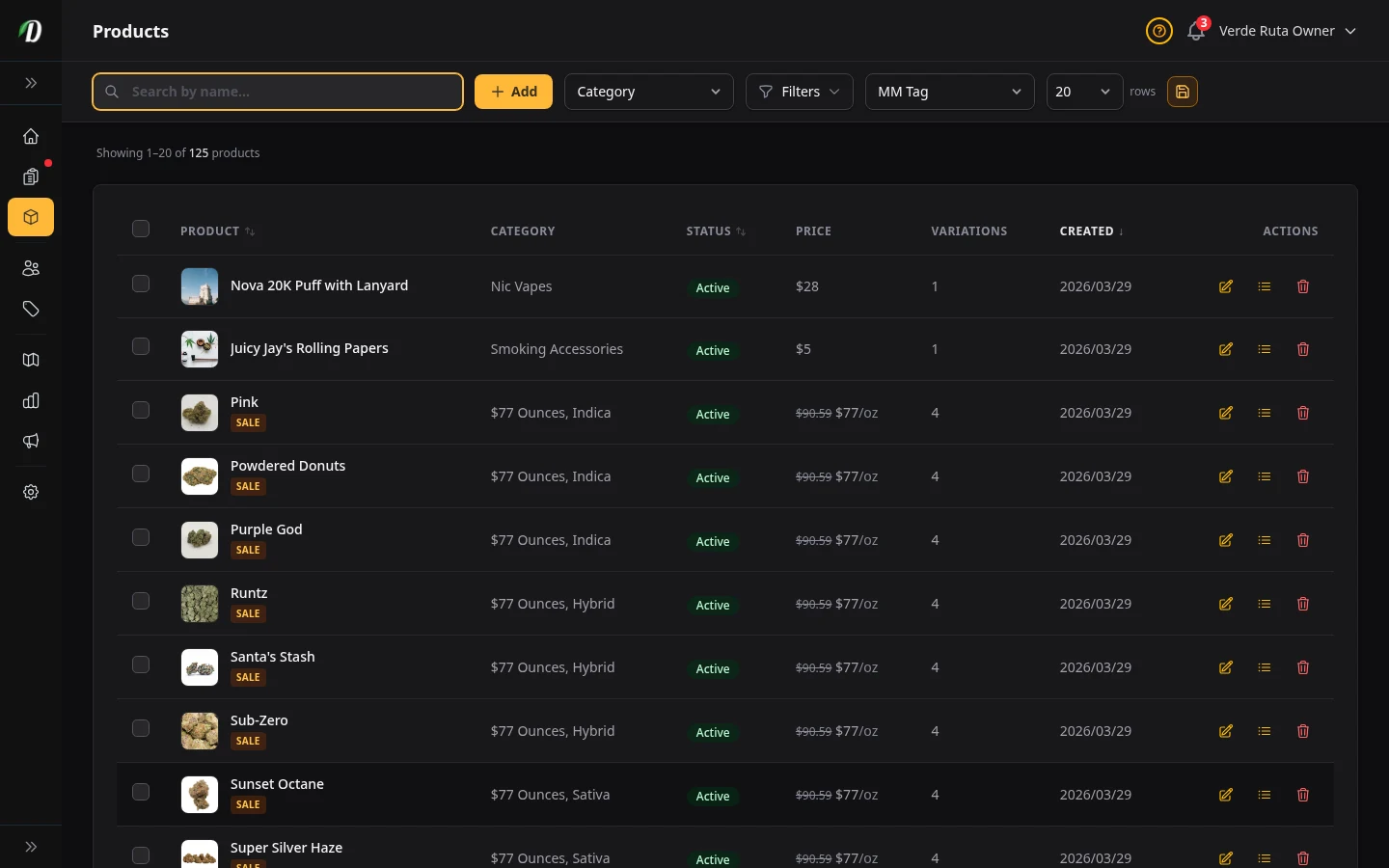
DabDash manages your product catalog, pricing, and inventory natively — no POS integration required to get your storefront live.
2. The Three-Bill Problem
Here is what a delivery operation built on Dispense looks like in practice, cost-wise:
Dispense / AIQ Ecommerce. Pricing is not publicly listed — you book a demo and get a quote. Based on operator communities and review platforms, expect a monthly fee in the range other cannabis eCommerce platforms charge, typically starting around $200–$400 per month for a single location, with pricing scaling up for multi-location operators and additional AIQ marketing tools.
Your POS. Dispense requires a connected POS to function. Cannabis-compliant POS systems — Cova, Flowhub, Treez, Blaze — typically run $300–$500 per month per location, with annual contracts common. This is the system that holds your actual inventory, processes your compliance records, and manages your product catalog. Dispense reads from it; it does not replace it.
Onfleet. If you need driver dispatch, route optimisation, and customer tracking links for your deliveries — and for a delivery business you do — you need Onfleet. Onfleet starts at roughly $149 per month for small delivery teams, climbing with task volume. This is a third subscription, a third login, and a third system your operations depend on.
Put those together and a single-location delivery operation is looking at $650 to $1,000 or more per month before a single order is processed. That is the cost of assembling a platform from three vendors instead of buying one.
There is also a non-monetary cost. Every integration point is a failure point. When your POS inventory does not sync to Dispense correctly, your online menu shows products that are out of stock. When Onfleet does not receive an order from Dispense, a driver never gets dispatched. When any of the three systems has a maintenance window or an API issue, your operations are affected by a problem you cannot control and cannot fix yourself.
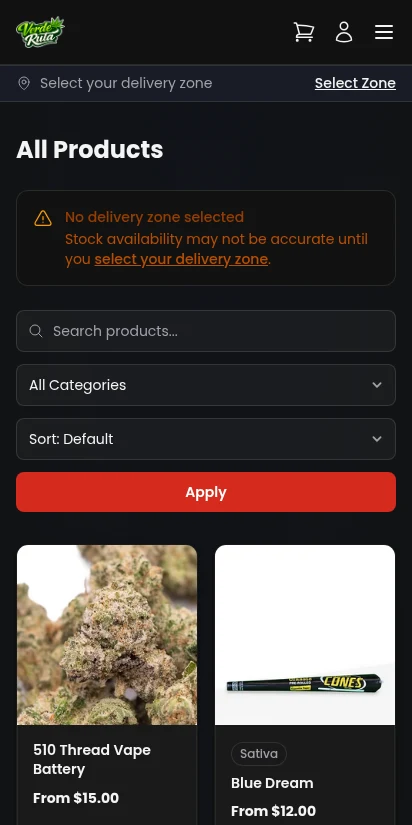
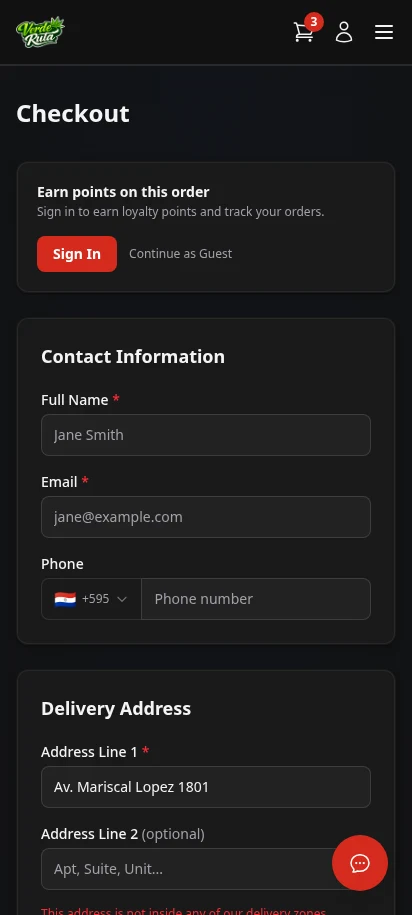
Dark mode — your menu, your domain. Fully indexed by Google from day one, no POS required to get live.
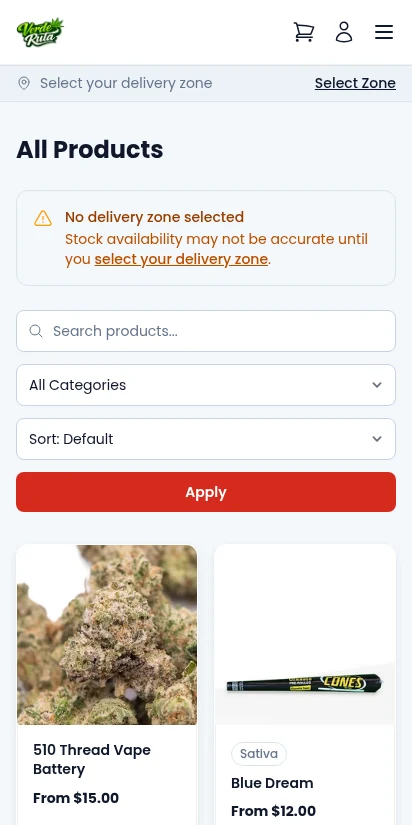
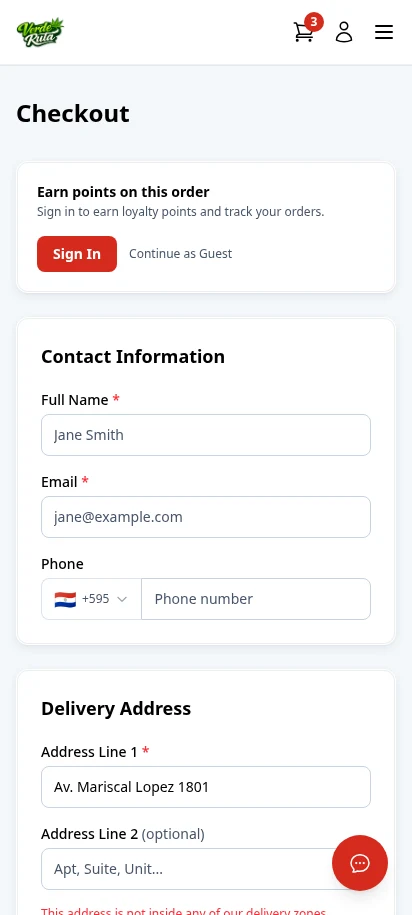
Light mode — server-rendered HTML on every page, structured data built in, visible to search engines without any separate integration.
3. The SEO Claim: Fair, but Contextual
The SEO story is the strongest part of the Dispense pitch, and it deserves to be taken seriously on its own terms.
Dispense product pages are server-rendered HTML on your domain — not iframed, not loaded by JavaScript after the fact. Google can crawl them. Each product gets a unique URL. XML sitemaps are generated automatically. Structured data is added for rich results. For dispensaries coming from an iframe-based menu provider, switching to Dispense can produce genuine, measurable SEO lift. The Ascend case study numbers — +586% ranking keywords, +110% impressions, +54% clicks — reflect a real phenomenon, not marketing fiction.
What that framing omits is that the same SEO architecture — server-rendered product pages, real URLs, structured data — is the baseline expectation for any modern storefront, not a differentiating feature. It is better than an iframe. But so is almost any platform that builds a native storefront rather than embedding a third-party menu.
The practical question is: does the SEO value of Dispense justify its cost on top of the POS and Onfleet costs you are already paying? For operators who have a retail dispensary with an existing POS they are committed to, and who need an SEO-optimised online storefront to layer on top, Dispense can make sense. For a delivery operator starting fresh who does not yet have a POS, the question is why you would buy three tools when one would do.
4. Delivery Management: What “Integrated” Actually Means
Dispense supports delivery orders — customers can place delivery orders through the storefront, and you can manage those orders through the Dispense dashboard. You can define delivery zones using their mapping tool or by uploading a GeoJSON file. Order confirmations and status updates are sent to customers.
But the delivery execution layer — driver assignment, route optimisation, driver tracking, proof of delivery — all of that lives in Onfleet. When a delivery order is placed in Dispense, it is automatically sent to Onfleet, where a dispatcher assigns a driver and the route is planned. Status updates flow back from Onfleet to Dispense and to the customer via SMS.
That handoff works when both systems are functioning correctly and the integration is healthy. The word “integrated” describes a data pipe between two separate products, not a unified platform. The dispatcher is looking at Onfleet. The storefront team is looking at Dispense. Your compliance records are in your POS. Three screens for one delivery.
For a large dispensary with a dedicated operations team, that setup is manageable. For a small delivery operation where one or two people are running everything, the cognitive overhead of three systems is a meaningful daily friction. And the monthly cost of three subscriptions is a meaningful line item before the first order ships.
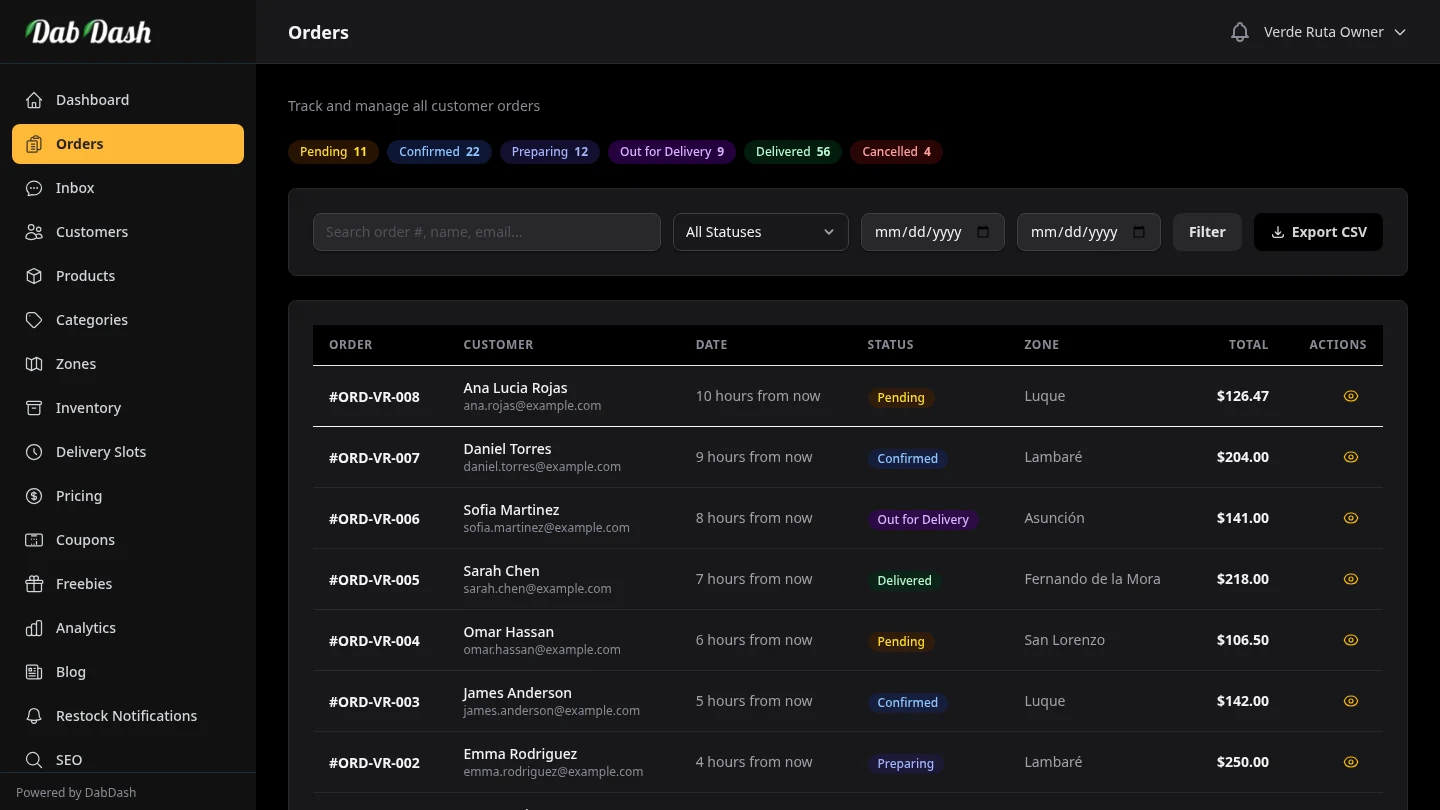
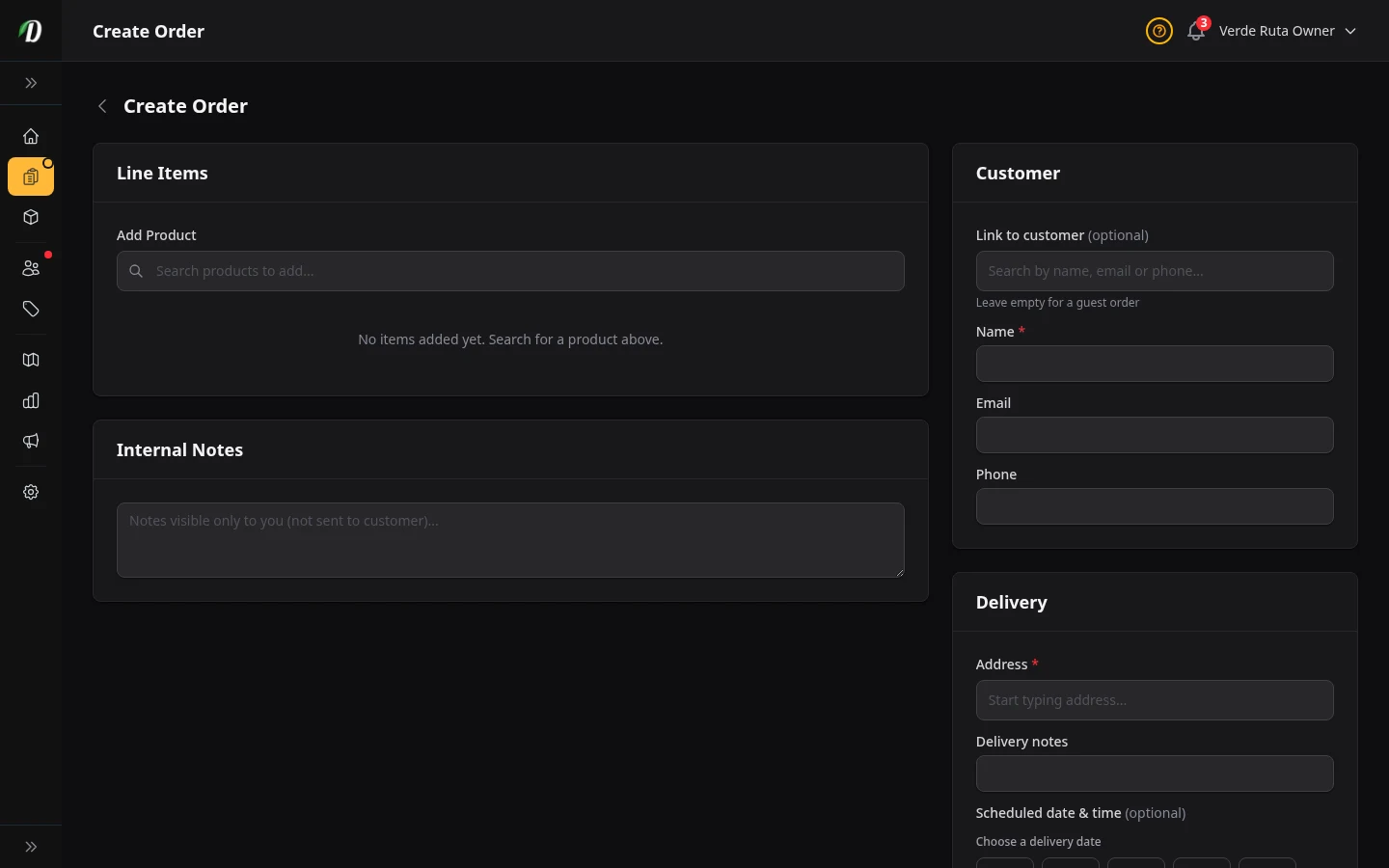
DabDash order management — every active order, every customer detail, every status update in one screen. No second dispatch tool required.
5. Who Dispense Is Actually Built For
To be fair about this: Dispense was designed for an operator who already has a retail dispensary with a POS in place and wants to add or improve their online storefront without replacing the system they already run their compliance and in-store operations on. That is a legitimate use case.
If you run a brick-and-mortar dispensary on Treez or Cova and you want better SEO for your online menu without migrating your entire POS, Dispense gives you an indexed storefront that syncs live from your existing system. The integration is clean, the SEO fundamentals are solid, and it sits alongside your existing infrastructure rather than replacing it.
Where Dispense is a poor fit:
Delivery-first operators starting fresh. If you do not already have a POS, you are buying three products to achieve what one integrated platform provides. The assembly cost in both money and operational complexity is significant.
Small operations where one person handles everything. Three systems with three logins is a meaningful daily overhead when the team is small.
Operators who want pricing transparency before buying. Dispense does not publish pricing. Every evaluation starts with a sales demo, which is a time cost before you can make a decision.
COD-focused delivery operations. Dispense integrates with cashless payment providers for US market operators who accept digital payments. For a cash-on-delivery model — common in Canadian markets — the payment integration stack is irrelevant, and the platform’s focus on payment provider partnerships does not add value.
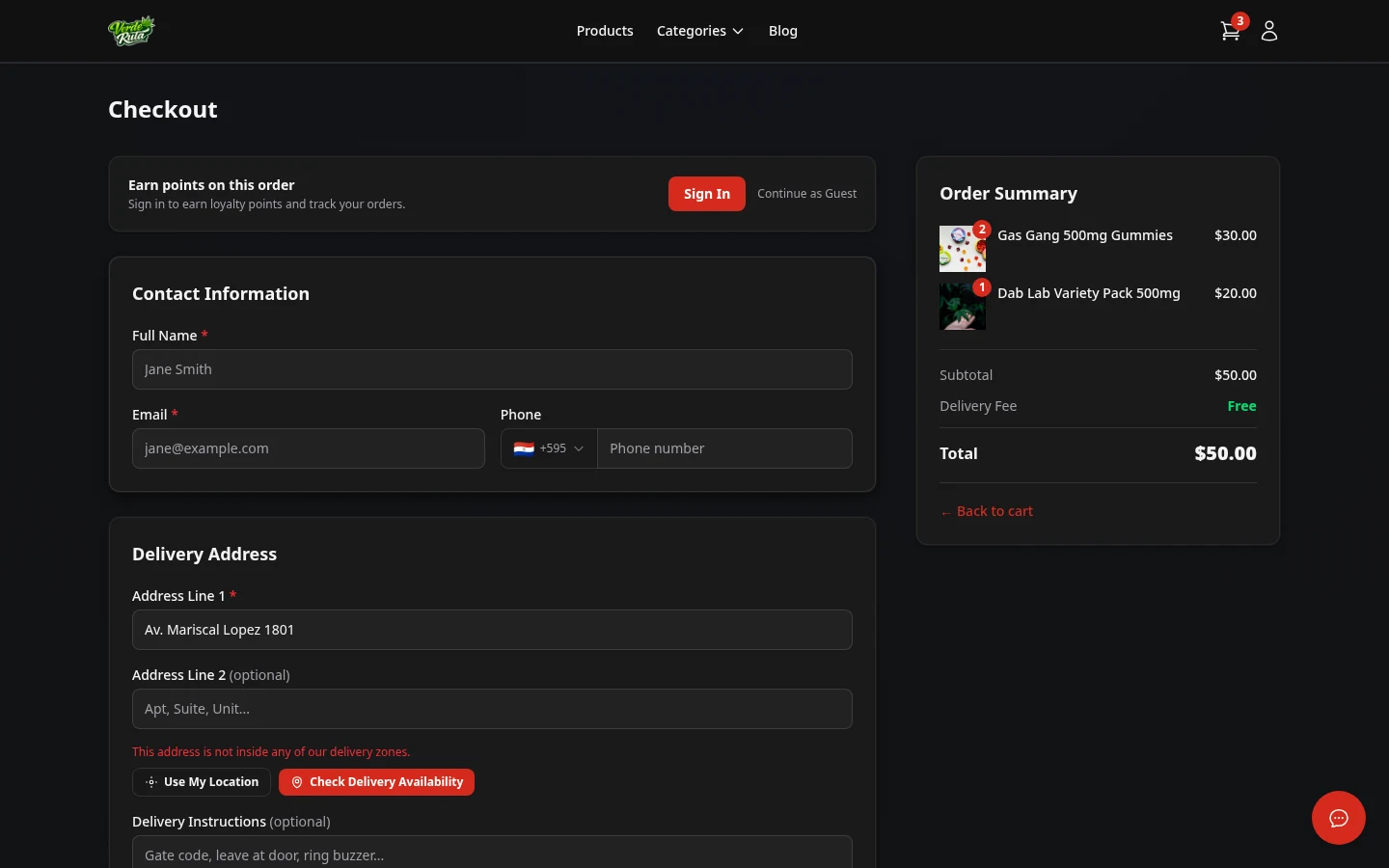
Dark mode — DabDash checkout is built for cash on delivery from the ground up. No payment processor integrations, no transaction fees.
Light mode — a clean, fast checkout flow with automatic delivery zone detection. No zone selection step, no friction.
6. DabDash vs. Dispense: What Changes When Everything Is in One Place
DabDash is built on a different premise. There is no POS integration because DabDash manages your product catalog directly. There is no Onfleet requirement because delivery zone management is native. There is no assembly required because the storefront, the order dashboard, and the delivery workflow are the same product.
The storefront is server-rendered HTML on your subdomain — every product page has a real URL, editable meta title and description, and structured data for rich results. The same SEO architecture Dispense advertises as a feature is the default in DabDash, not an add-on layer.
Delivery zones are drawn using a map tool inside your vendor dashboard. When a customer visits your storefront, their delivery coverage is checked automatically based on their address — they do not select a zone or take any extra step. Orders arrive in real time. You manage them from the same screen your team already uses for products and settings.
The tradeoff is scope: DabDash is built for delivery-first operators, not for brick-and-mortar retail dispensaries that need compliance POS functionality. If your primary channel is delivery and you do not run a retail floor, that tradeoff costs you nothing. If you need a retail POS with Metrc compliance, DabDash is not the right tool — and a platform like Flowhub or Treez paired with Dispense may serve you better.
DabDash vs. Dispense: Feature Comparison
Feature
Dispense (AIQ Ecommerce)
DabDash
Pricing transparency
Quote-based — no published rates
Transparent, published pricing
POS required
Yes — inventory syncs from your POS
No — product catalog managed natively
Driver dispatch & routing
Via Onfleet integration (separate cost)
Native delivery zone management, included
SEO-indexed storefront
Yes — server-rendered, structured data
Yes — server-rendered, structured data
Delivery zone mapping
Yes — UI tool or GeoJSON upload
Yes — polygon drawing tool in dashboard
Customer payments
Cashless debit, ACH, payment integrations
Cash on delivery — no payment processing fees
Number of systems needed
3 (Dispense + POS + Onfleet)
1
Retail POS / Metrc compliance
Via connected POS
Not included — delivery-focused only
Acquired by / parent company
Alpine IQ (acquired March 2024)
Independent
Free trial
Not available — demo required
Available
The Bottom Line
Dispense is an honest product. It does what it says: it provides an SEO-optimised online storefront for cannabis dispensaries, and it does that part well. The indexed product pages are real, the structured data is real, and the SEO lift it produces over iframe-based alternatives is documented and legitimate.
The issue is not what Dispense does. It is what Dispense is: a layer, not a platform. Behind the storefront, you still need a POS to hold your inventory, and you still need Onfleet to dispatch your drivers. That is three monthly bills, three systems with three support contacts, and three integration points that need to stay healthy for your operations to run.
For a delivery-first operator who has not yet committed to a POS and wants a single system to run their business, that architecture is the wrong direction. You are paying for the privilege of assembling tools that a purpose-built delivery platform includes by default.
DabDash is not the right fit for every operator. If you run a multi-location retail dispensary on Metrc and your biggest need is a better online menu, Dispense may be exactly what you want. But if you are building a delivery business and you want one platform that covers your storefront, your product catalog, your delivery zones, and your order management — without three logins and three bills — the assembly approach costs more than it needs to.
Ready to see one platform do what three currently do?Start your free DabDash trial and have your SEO-indexed storefront live today.
FAQ
Common Questions About DabDash vs. Dispense: Why Pay for Half a Platform?
Quick answers to the most common follow up questions readers search after exploring this topic.
What is Dispense cannabis software?
Dispense (now branded AIQ Ecommerce following its acquisition by Alpine IQ in March 2024) is an online ordering and eCommerce platform for cannabis dispensaries. It provides an SEO-indexed storefront on your own domain, an order management dashboard, and integrations with major cannabis POS systems. Dispense is not a standalone platform — it requires a connected POS to sync inventory and relies on Onfleet for driver dispatch and delivery routing.
Does Dispense replace a cannabis POS?
No. Dispense is designed to work alongside an existing POS, not replace one. Products, stock levels, and pricing are pulled from your connected POS (such as Cova, Flowhub, Treez, or Blaze) in real time. If you do not have a compliant cannabis POS, you will need to set one up separately before Dispense can function as intended.
How much does Dispense cost per month?
Dispense does not publish its pricing. All plans require a sales demo before quotes are provided. Based on operator communities and review platforms, estimates for single-location eCommerce plans run in the range of $200 to $400 per month, but final pricing depends on your size, location count, and which AIQ marketing tools you include. The total cost of ownership should also factor in your POS subscription (typically $300 to $500 per month) and Onfleet for delivery dispatch (starting around $149 per month).
Does Dispense include delivery management?
Dispense handles online delivery orders and lets you define delivery zones. For driver dispatch and route optimisation, Dispense integrates with Onfleet, which is a separate paid service. Orders placed through Dispense are sent automatically to Onfleet, where drivers are assigned and routes are planned. This means delivery-focused operators need an active Onfleet account in addition to Dispense and their POS.
Is Dispense good for SEO?
Yes. Dispense generates server-rendered product pages on your own domain with real URLs, auto-generated XML sitemaps, and structured data markup — a significant improvement over iframe-based menu solutions that Google cannot index. A documented case study with Ascend Wellness showed a 586% increase in ranking keywords after switching to Dispense from an iframe menu. The SEO fundamentals are solid for dispensaries coming from embedded third-party menus.
Who acquired Dispense?
Dispense was acquired by Alpine IQ in March 2024 and is now part of the AIQ product suite, branded as AIQ Ecommerce. Alpine IQ is a cannabis retail marketing and data platform. The core Dispense eCommerce product remains largely unchanged in architecture — it is still an online ordering layer that sits on top of a separately managed POS.
What is the best Dispense alternative for delivery-first cannabis operators?
DabDash is designed specifically for delivery-first cannabis operators. Unlike Dispense, DabDash does not require a separate POS or a separate dispatch tool: the product catalog, delivery zone management, and order management are all native. The storefront is server-rendered HTML on your subdomain with the same SEO fundamentals Dispense offers, and there is no assembly of multiple vendors required to get operational.
What are the main differences between DabDash and Dispense?
The core difference is completeness. Dispense is an eCommerce layer that requires a connected POS for inventory and Onfleet for delivery management — three separate systems for a full delivery workflow. DabDash manages the product catalog, storefront, delivery zones, and orders natively in one platform. Both offer SEO-indexed, server-rendered storefronts on your own domain. Dispense is better suited to existing retail dispensaries that already run a POS and want to add an online menu. DabDash is better suited to delivery-first operators who want one system without assembly.