IndicaOnline was built in 2011 for medical dispensaries. If you run a delivery-first recreational operation today, you're inheriting fifteen years of patient-management architecture you never needed — and an iframe menu Google can't read.
IndicaOnline was founded in 2011 — the same year Colorado and Washington were still two years away from legalizing recreational cannabis. The world it was built for had patient files, physician verifications, and HIPAA-certified medical records at its core. That world still exists. But for every operator running a modern delivery business in 2026, it is no longer the whole picture.
If you are evaluating IndicaOnline as a platform for your cannabis delivery operation, this is the honest breakdown. Not a sales pitch in either direction — just a clear look at what IndicaOnline was designed to do, where that design shows its age, and what a delivery-first operator actually needs from their software.
1. Built in the Medical Era — Sold Everywhere Else
IndicaOnline’s origin story is medical marijuana. Their homepage has historically led with "patient management," their software is HIPAA certified for medical record storage, and their earliest feature set — physician verification, patient card scanning, electronic medical records — was built for the compliance requirements of state-run medical programs in the early 2010s.
That heritage shaped every architectural decision the company made. The database thinks in patients. The compliance engine was built around state medical board requirements. The language throughout the product — "patient," "physician," "medical record" — reflects the world it was designed for.
There is nothing wrong with that if you run a medical dispensary in a state where that infrastructure still matters. But for the overwhelming majority of new cannabis operators today — recreational delivery services, adult-use storefronts, multi-zone delivery businesses — you are inheriting fifteen years of medical-era architecture that your operation never needed.
One long-time Capterra reviewer put it bluntly: "It seems to be better suited for a recreation program, rather than medical" — the inverse of what you might expect, suggesting that even the medical-first architecture no longer serves either market cleanly.
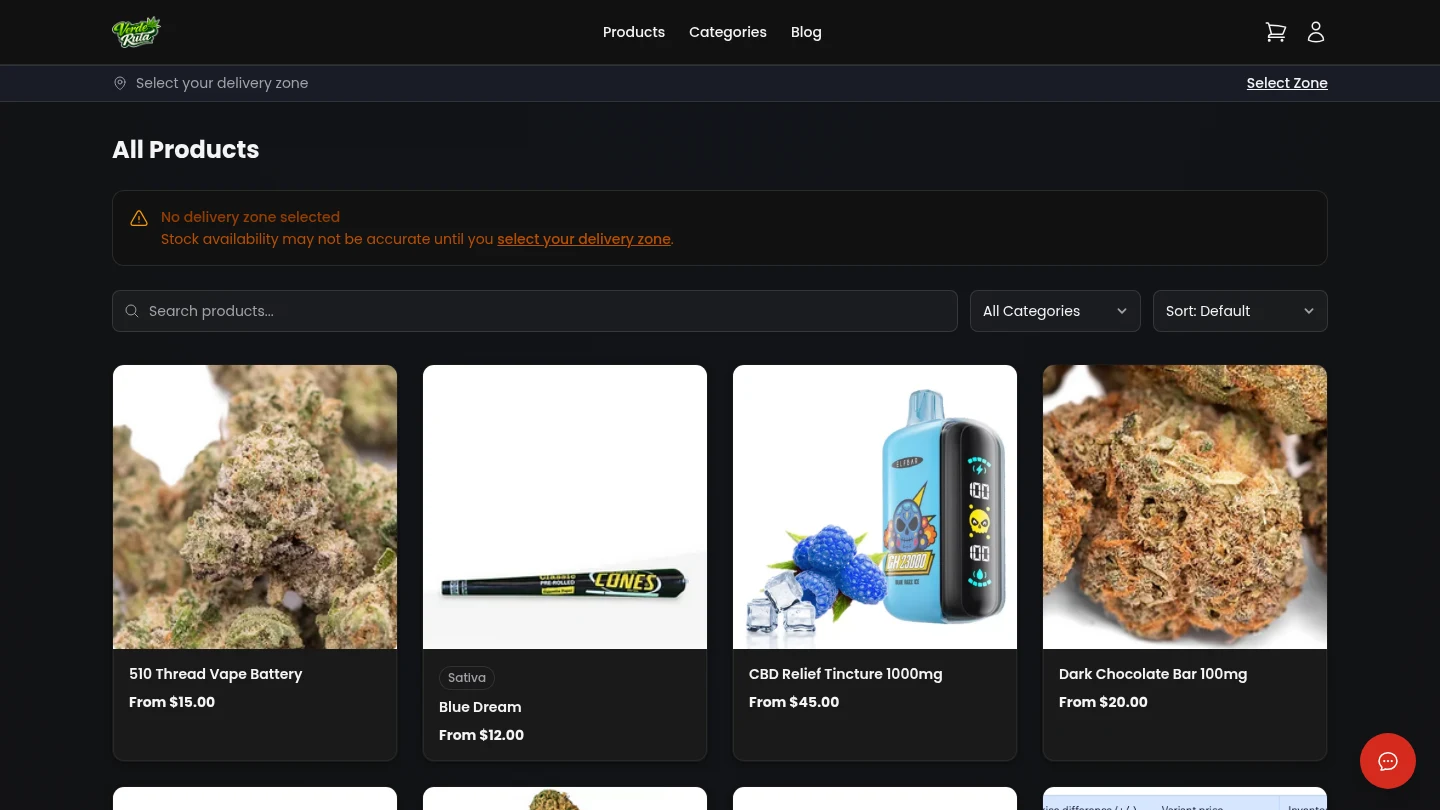
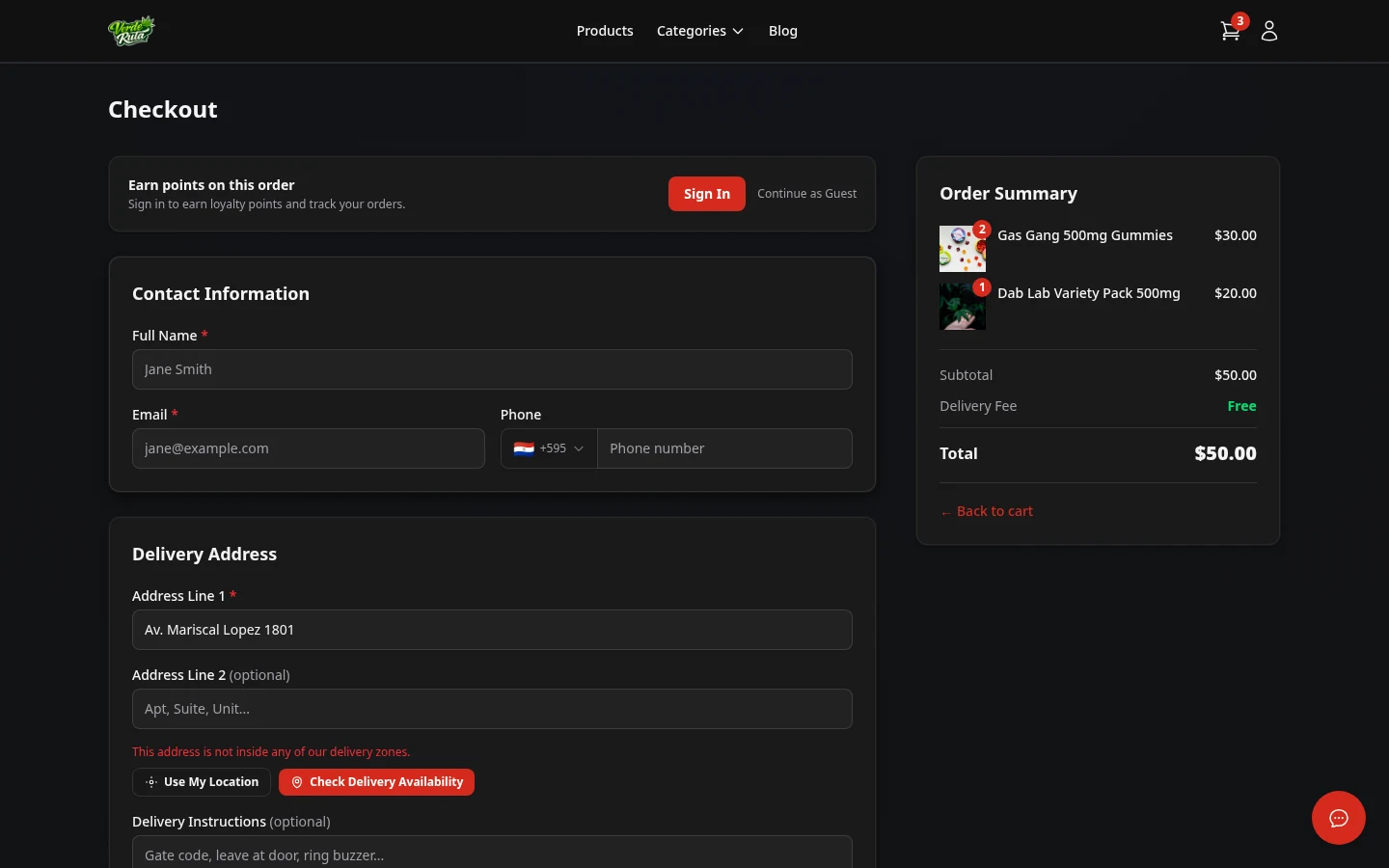
DabDash storefront — built from the ground up for delivery-first recreational operators. No patient files, no medical records, no legacy compliance overhead.
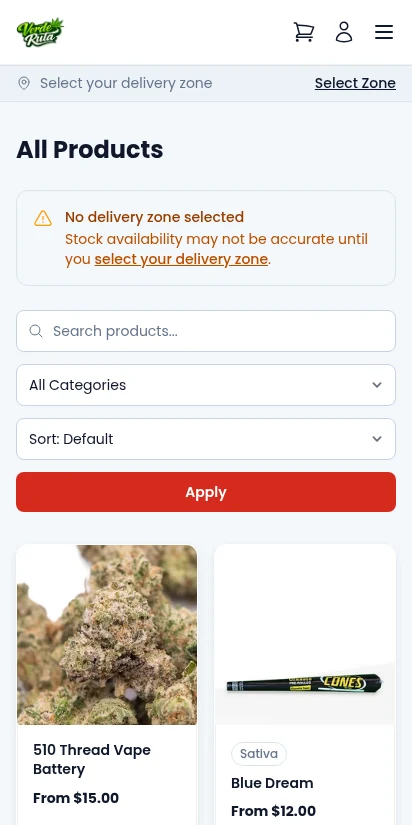
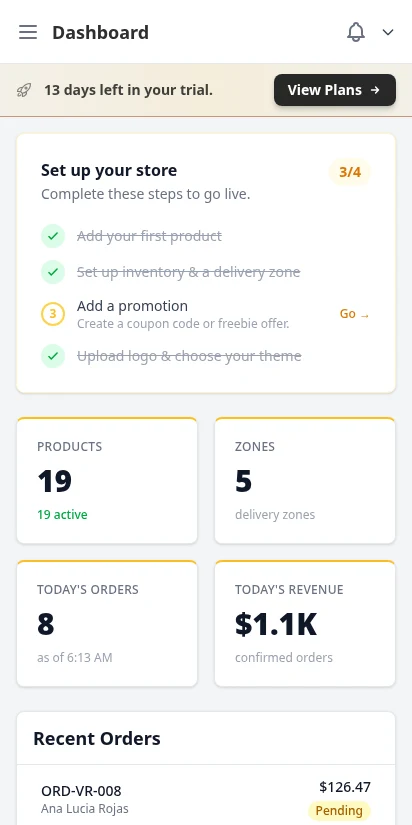
Mobile — light mode. A modern storefront your customers actually want to use.
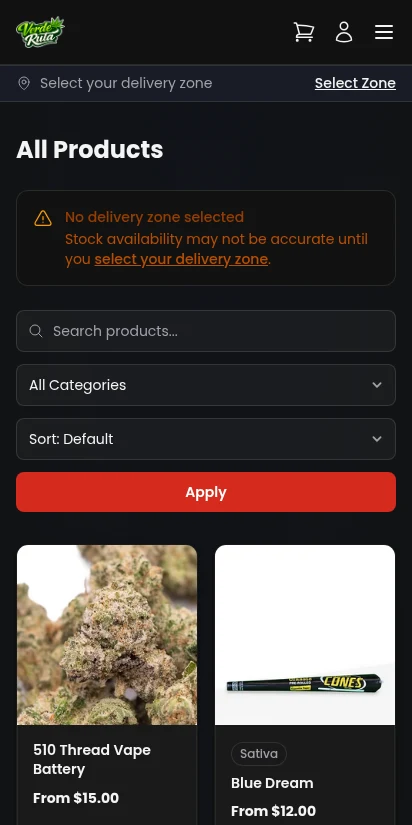
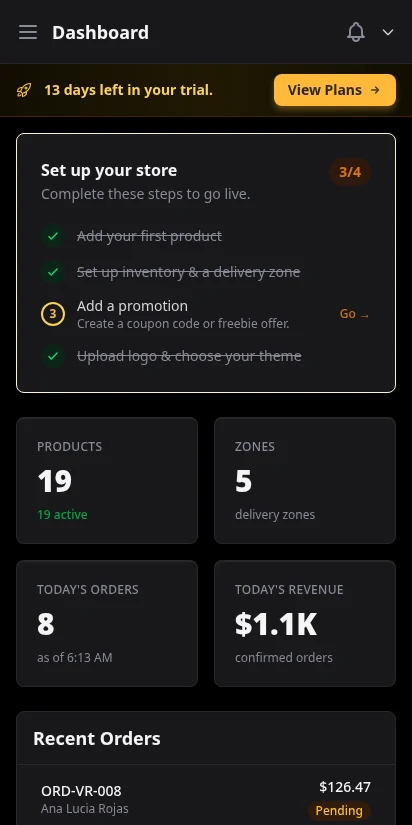
Mobile — dark mode. Same experience, no medical-era overhead.
2. The iframe Question: What Google Can and Cannot See
This is the most important technical issue for any cannabis operator who wants to rank on Google — and it is where IndicaOnline’s architecture creates a real problem.
IndicaOnline offers their online menu through Sweede, their eCommerce platform. Sweede gives you two integration options: an iframe embed and a subdomain-based approach. Their own support documentation describes the iframe option as a way to “get up and running quickly with a sophisticated, easy-to-use menu that blends seamlessly into your website and can be launched with just one line of code.”
That one line of code has a major cost: Google cannot read an iframe.
When your menu is loaded inside an iframe, search engine crawlers see a blank container on your page — not your product names, strain descriptions, pricing, or category pages. Every product you upload, every description you write, every category page you build is invisible to Google’s index. Your dispensary page may rank for your business name. Your individual products, strains, and menus will not rank for anything.
IndicaOnline acknowledges this in their own materials, noting that their subdomain approach is “positioned as the solution for those looking to boost SEO.” That framing tells you everything: SEO is a separate option you have to seek out, not the default. The quick-start path — the one they lead with — is the iframe, which is the path that kills your Google ranking.
For a delivery business that competes on local search — "cannabis delivery near me," strain-specific queries, category pages, product URLs — this is not a minor inconvenience. It is a fundamental structural disadvantage that hands your Google real estate to competitors.
DabDash builds every product page as a real, crawlable URL on your own domain. There are no iframes. Every product, every category, every strain description is indexed by Google the moment you publish it. Your store ranks. Your products rank. Your delivery zone pages rank.
3. Pricing: What $299/Month Actually Gets You
IndicaOnline publishes their pricing, which is more than most cannabis software companies do. Here is what the numbers look like in practice:
Plan
Monthly Price
POS Licenses
Key Inclusions
Basic
$299/month
2 licenses
Core POS, inventory, compliance
Elite
$499/month
5 licenses
Multi-location, loyalty, RFID audits
Distribution
$699/month
—
Distribution-focused operations
Sweede (the eCommerce platform) is included for IndicaOnline POS subscribers at no extra cost — that is a genuine plus compared to platforms that charge separately for online ordering. But "included" does not mean "built for delivery SEO." The iframe default issue remains regardless of what you pay.
The more important question is what you are paying for. At $299–$499/month, IndicaOnline is charging you for a full dispensary POS infrastructure: compliance reporting, physician verification, patient record management, RFID inventory scanning, and an offline mode for in-store transactions. If your business is delivery-only, you are paying for a substantial amount of software architecture that serves a store model you do not operate.
DabDash is built exclusively around the delivery model — meaning every feature you pay for is a feature that directly moves product from your warehouse to your customer’s door.
4. The Inventory Problem Real Users Are Reporting
Software review platforms tell a consistent story about one area where IndicaOnline struggles: inventory accuracy.
One verified reviewer described the situation plainly: "Inventory amounts change overnight. Lately it’s been doubling — yes, DOUBLING — expected inventory values, making end of day inventory reconciliation a nightmare."
Another wrote that the system "does a handful of things in a mediocre fashion — POS checkout, barcode scanning is a 0 success on any given day, even RFID inventory scans can be great when they work."
A third flagged that "many features shown in the demo don’t work and won’t be fixed," and noted that customers cannot use SMS through the POS without carrier blocking, with the issue left unresolved for extended periods.
These are not edge cases — inventory reliability is table stakes for a cannabis operation. Inventory errors in a regulated market are not just an operational inconvenience; they are a compliance risk. When your software doubles your inventory count overnight, your end-of-day reconciliation report is wrong, and your state compliance filing may be wrong with it.
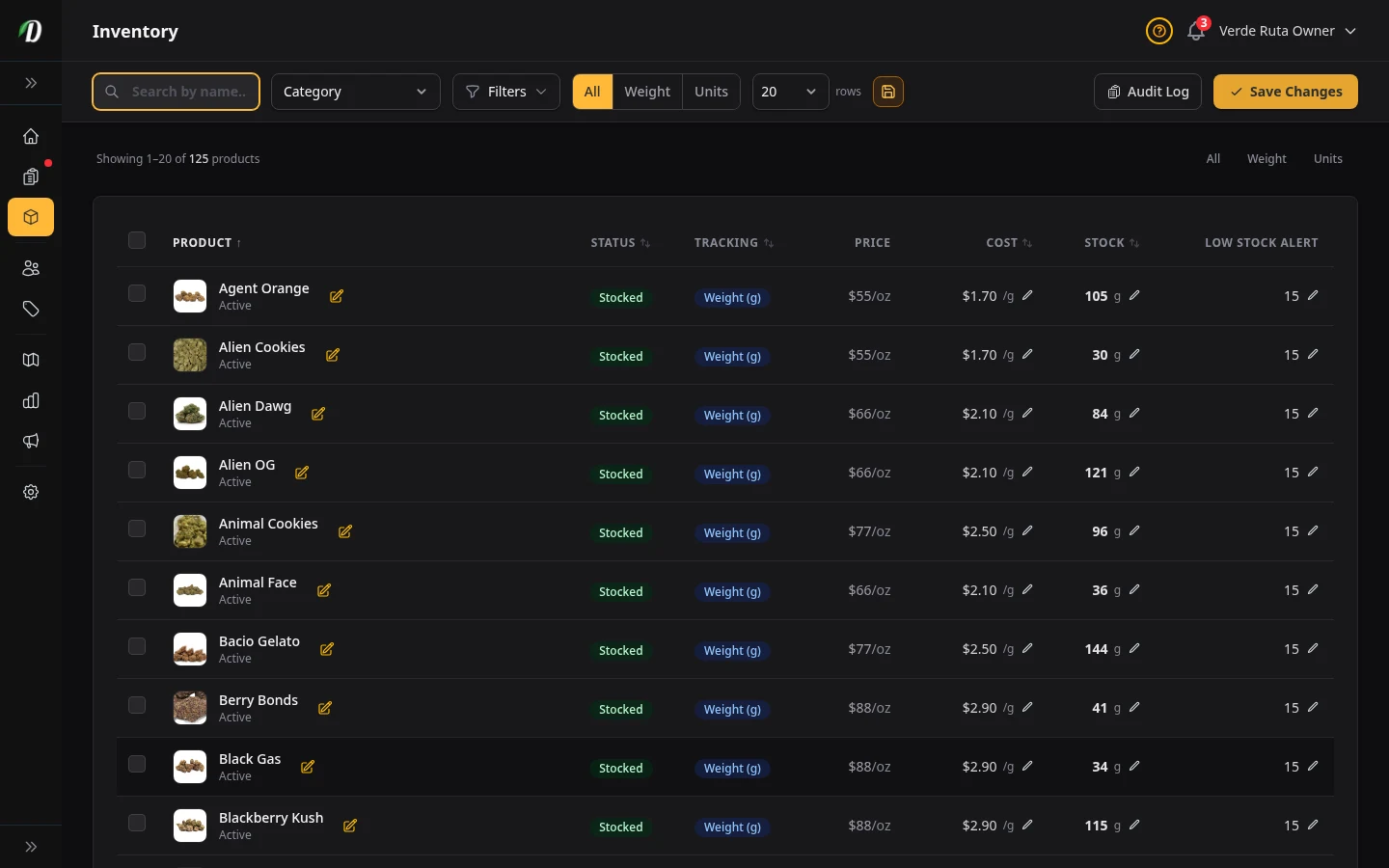
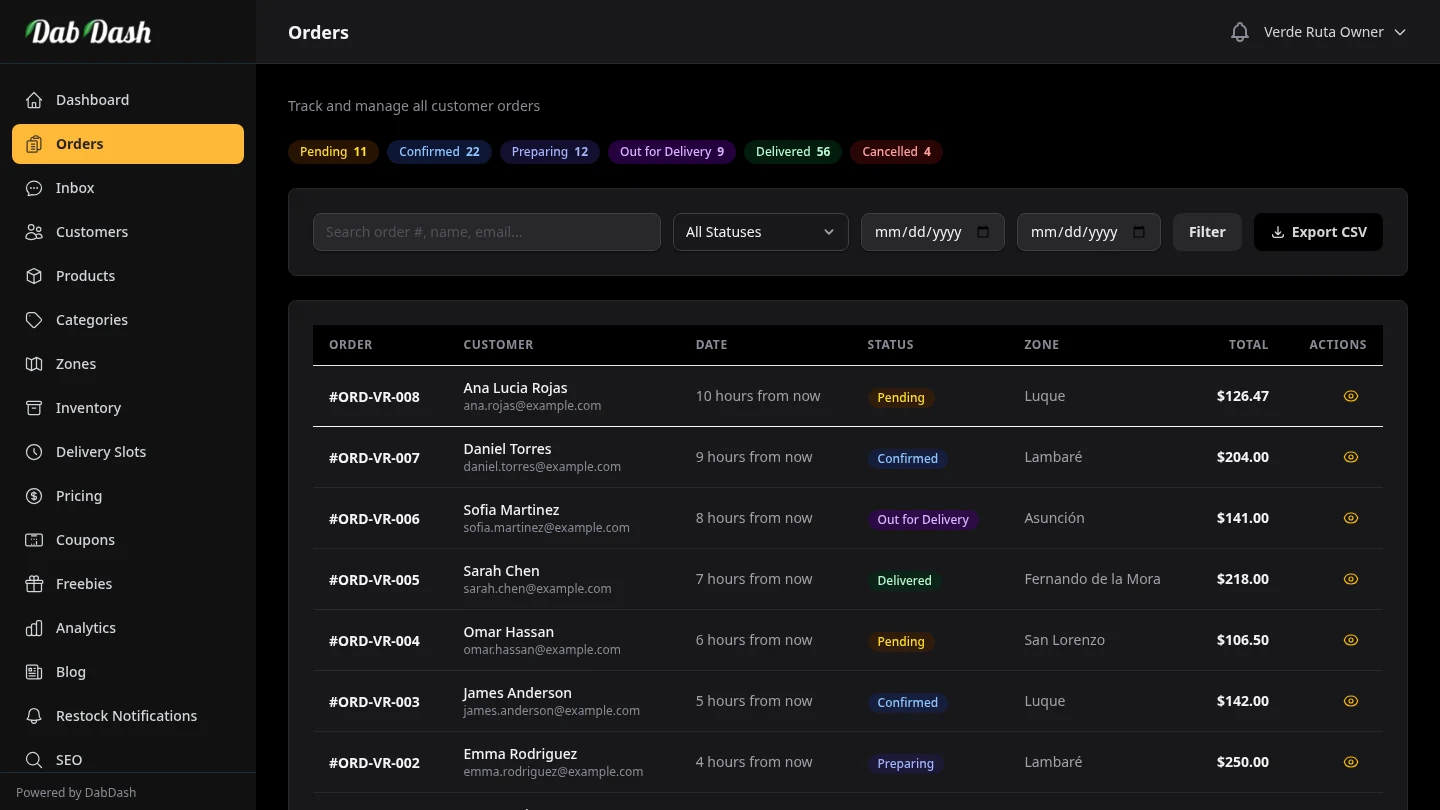
DabDash inventory — clean, accurate, and built around the delivery model. What you see is what your drivers pick.
5. Delivery: The Feature That Should Be the Core
IndicaOnline does have a delivery module. They have driver tracking, route optimization, and a driver app. For a company that started in the medical dispensary space, adding delivery features over the years makes sense as the market shifted.
But there is a meaningful difference between a platform that was designed for delivery and one that has delivery added on. Delivery in IndicaOnline exists alongside a full dispensary POS system — physician verification, patient management, in-store checkout workflows, RFID scanning, register management, offline mode for counter transactions. You are navigating a system built for a store counter and finding the delivery features somewhere in it.
On DabDash, there is no in-store anything. There is no register. There is no counter workflow. There is no patient file. Every screen, every feature, every default assumes a single workflow: customer orders online, driver picks up, driver delivers, customer pays cash at the door. The delivery model is not one tab in a larger system — it is the entire system.
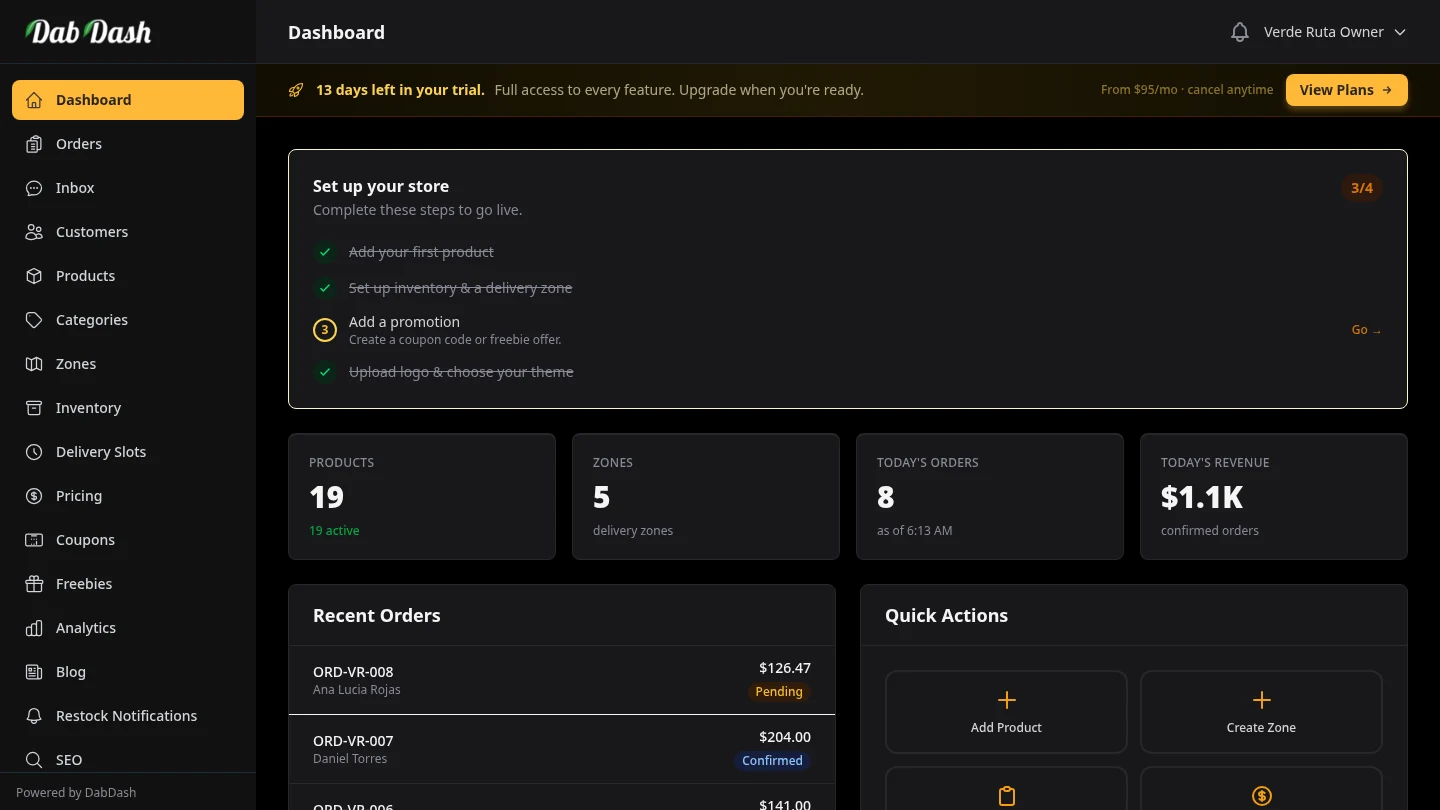
Vendor dashboard — dark mode. Live orders, revenue, and delivery status from your phone.
Vendor dashboard — light mode. Everything you need to run a delivery operation, nothing you don’t.
6. Cash on Delivery vs. Cashless Complexity
IndicaOnline offers "SWIPE — POBS," a cashless payment option for processing debit transactions in the dispensary. They also integrate with various cannabis-friendly payment processors for online ordering.
Cannabis banking remains genuinely complicated in 2026. Cashless ATM schemes, ACH workarounds, and debit processing through cannabis-friendly payment processors carry ongoing risks — account freezes, processor terminations, and regulatory scrutiny that can disrupt your payment infrastructure with little warning. Every month you run a cashless payment system in cannabis is a month where that infrastructure could change.
DabDash is Cash on Delivery only. Your driver delivers the order. Your customer pays in cash at the door. You keep every dollar without a processing fee, an interchange cut, or a fintech relationship. No bank integration, no payment processor dependency, no risk of a frozen merchant account. The oldest, most reliable transaction in retail — cash changes hands at delivery.
The Quick Comparison
Feature
IndicaOnline
DabDash
Founded / designed for
2011 — medical dispensary POS
Delivery-first recreational operators
Online menu SEO
iframe by default — Google cannot index it
Real pages on your domain — fully indexed
Patient management / HIPAA
Yes — core feature
Not applicable — delivery focus only
Monthly software cost
$299–$699/month
One flat delivery-focused price
Delivery as core vs. add-on
Added feature in a dispensary POS
The entire product
Payment model
Cashless ATM / debit processing
Cash on delivery — no processing fees
Inventory reliability
User-reported accuracy issues
Purpose-built for delivery stock tracking
Setup time
Days to weeks
Same day
Who Should Use IndicaOnline
To be fair: IndicaOnline is not a bad product for what it was designed to do. If you run a medical dispensary in a state with active medical programs, patient verification requirements, and HIPAA-adjacent compliance obligations — IndicaOnline was built with your specific needs in mind. The long-term users who have expanded from small delivery services to managing hundreds of drivers and multiple storefronts are a real testament to what the platform can handle at scale.
But if you are building a delivery-first recreational cannabis business in 2026, you are not the customer IndicaOnline was designed for. You are buying fifteen years of medical-era infrastructure that your operation does not need, navigating an iframe-based eCommerce default that actively hurts your Google ranking, and working around inventory reliability issues that verified users have flagged in public reviews.
The Bottom Line
The cannabis market has moved. The fastest-growing segment in legal cannabis is recreational delivery — customers ordering online, expecting a clean mobile experience, paying at the door, and leaving a Google review. That market needs software that was designed for it from day one: a real, indexed storefront, a delivery-native order workflow, and a payment model that does not depend on cannabis-friendly fintech staying online.
DabDash is built for exactly that operator. No patient files. No iframe menus. No cashless ATM risk. Just a storefront Google can read, orders you can manage from your phone, and cash at the door.
Common Questions About DabDash vs. IndicaOnline: Is Your Software Still Living in the Medical Era?
Quick answers to the most common follow up questions readers search after exploring this topic.
Is DabDash a good IndicaOnline alternative for delivery operators?
Yes — particularly for delivery-first recreational operators. IndicaOnline was built in 2011 for medical dispensaries, with patient management, HIPAA compliance, and in-store POS as its core features. DabDash is built exclusively for delivery operations: no patient files, no in-store workflows, no medical-era overhead. Every feature is designed around the delivery model — online storefront, order management, driver operations, and cash on delivery.
Does IndicaOnline use iframes for its online menu?
Yes — iframe embed is IndicaOnline's default quick-start option for their Sweede eCommerce platform. Their support documentation describes it as a way to launch "with just one line of code." The problem is that Google cannot index content inside an iframe, which means your products, strains, and menu pages are invisible to search engines. IndicaOnline does offer a subdomain-based alternative for better SEO, but it is not the default path.
Can Google index my IndicaOnline menu?
Not when using the iframe embed option, which is IndicaOnline's default eCommerce integration. Content inside an iframe is not crawlable by Google, which means your product pages, strain descriptions, and category pages will not appear in search results. DabDash builds every product as a real, crawlable page on your domain — fully indexed by Google from the moment you publish.
How much does IndicaOnline cost per month?
IndicaOnline's Basic plan is $299/month (2 POS licenses) and the Elite plan is $499/month (up to 5 POS licenses). Their Distribution plan is $699/month. Sweede (their eCommerce platform) is included for POS subscribers. The pricing reflects a full dispensary POS suite — including patient management, HIPAA compliance, RFID scanning, and in-store checkout — much of which a delivery-only operator will not use.
Does IndicaOnline have delivery features?
Yes — IndicaOnline includes a driver app, route optimization, and delivery tracking. However, delivery is one module within a larger dispensary POS system designed originally for in-store medical dispensary operations. For delivery-first operators, DabDash is built entirely around the delivery workflow, with no in-store POS complexity to navigate.
What do real users say about IndicaOnline?
Long-term users on Capterra and G2 praise the driver tracking and route optimization features. However, verified reviewers have also flagged inventory accuracy issues — including inventory values doubling overnight — as well as barcode scanning reliability problems and features demoed that are not yet functional. One reviewer noted that the software seems "better suited for a recreation program, rather than medical," which is the inverse of what you might expect given its medical-era origins.
Does DabDash support cashless payments or debit processing?
No — and that is intentional. DabDash is cash on delivery only. Your customer pays the driver in cash when their order arrives. This eliminates payment processing fees, the risk of merchant account freezes, and the ongoing compliance complexity of cashless ATM or debit processing schemes that are common in the cannabis industry.
How quickly can I get started with DabDash compared to IndicaOnline?
Most DabDash operators are live and taking their first order the same day they sign up. There is no hardware to configure, no compliance officer call to schedule, and no patient database to set up. IndicaOnline implementations typically take longer, given the scope of the dispensary POS configuration, compliance setup, and hardware provisioning involved in getting the full system running.