Inventory Management
Track zone-level stock, audit changes, and prevent overselling.
Overview
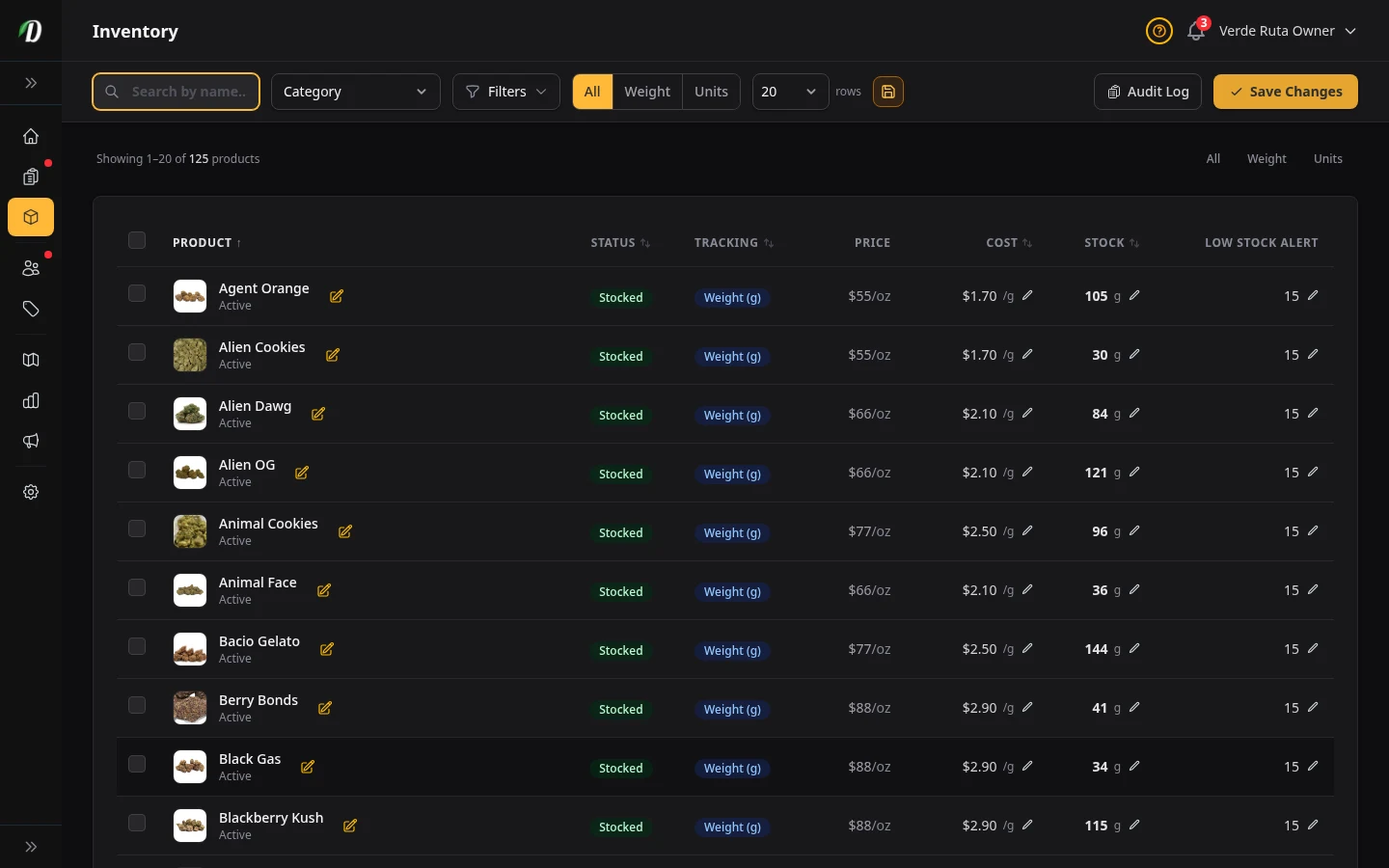
The Inventory page is where you update and monitor stock levels for every product and variation in your menu. You can edit quantities directly in the table, apply bulk adjustments across multiple items at once, and set low-stock alert thresholds to get notified before you run out.
Stock is tracked at the product or variation level, not by delivery zone. Every active zone draws from the same stock pool.
Tracking Types
Use the tabs at the top of the page to filter by how products are measured.
| Tab | What it shows |
|---|---|
| All | Every product and variation regardless of tracking type. |
| Weight | Items sold in grams or ounces (flower, concentrates). Stock is measured in grams. |
| Units | Items sold as individual pieces (pre-rolls, edibles, capsules). Stock is a whole-number count. |
Search & Filters
The sticky filter bar at the top of the page lets you narrow down the list without losing your tracking-type tab.
- Search
- Type any part of a product or variation name to filter the list instantly.
- Category
- Filter to one product category so you can focus on a single product type.
- Stock Status
- Filter to In Stock, Low Stock (below the alert threshold), or Out of Stock to quickly find items that need restocking.
Table Columns
Each product row in the inventory table displays several columns. Sortable column headers let you re-order the table.
- Product
- Product image, name, and SKU. Click the expand arrow to reveal individual variations.
- Price
- Read-only anchor price. For weight products, this shows the heaviest tier (e.g. the 1 oz price). For unit products, it shows the price or a range if variations differ. Products on sale show the original price crossed out. Variation sub-rows show their individual prices.
- Cost
- Click any cost cell to edit it inline. Cost is per gram for weight-tracked items or per unit for unit-tracked items. Saving updates COGS calculations across analytics.
- Stock & New Qty
- Current stock level and an editable field for the new quantity. Changed rows are highlighted in blue.
- Low Stock Alert
- The reorder threshold. When stock drops to or below this number, the item is flagged as "Low Stock".
Matrix Products — Grouped View
Products using a Matrix pricing structure (Variation × Weight or Variation × Unit) display a grouped layout when expanded. Variations are grouped by their label (e.g. flavour or strain name), with a header row for each group.
Group header rows are editable — set the cost, stock quantity, and low-stock threshold at the group level. Individual size sub-rows within each group are read-only and inherit from the group.
Three-level checkboxes make bulk selection intuitive: a top-level "Select All" checkbox controls the entire product, product-level checkboxes control all groups within that product, and group-level checkboxes control individual variations within a group. Partially selected groups show an indeterminate (dash) state.
Updating Stock Quantities
To update stock, type a new value in the New Qty column next to any product or variation. You can edit as many rows as you need — changes are highlighted in blue so you can see what is pending. When you are ready, click Save Changes at the top of the page to apply all edits at once.
For weight-tracked items, quantities are in grams. For unit-tracked items, quantities are whole numbers.
Products with multiple variations (such as 1g, 3.5g, 7g) display a collapse button — click the row to expand and edit each variation individually. Matrix products group variations by label — see Matrix Products above.
Low-Stock Alert Thresholds
The Low Stock Alert column lets you set a reorder point for each product or variation. When the current stock drops to or below this number, the item is flagged as "Low Stock" in the table and in your notifications.
Set the threshold to 0 or leave it blank to disable the alert for that item.
Bulk Stock Adjustments
When you need to update many items at once — for example, after a large delivery — use bulk adjustment instead of editing each row individually.
- Check the box next to each product or variation you want to adjust. Use the top checkbox to select all items on the current page.
- The floating action bar appears at the bottom of the screen once items are selected.
- Choose an action: Set (replace the current quantity), Add (add to the current quantity), or Subtract (reduce by a fixed amount).
- Enter the amount and click Apply. A confirmation dialog appears showing a summary of the adjustment before it is applied.
You cannot bulk-adjust a mix of weight-tracked and unit-tracked items at the same time. Use the tracking-type tabs to filter to one type before selecting.
Viewing the Full Change History
Every stock movement is recorded automatically — manual edits, bulk adjustments, order confirmations, and refunds. Click Inventory Changes in the top-right corner of the Inventory page to open the dedicated report.
The Inventory Changes report has its own trend charts, stat cards showing net weight and unit changes, and a filterable change log with date range, product search, and action-type filters. Order-linked rows link directly back to the originating order.
Full details: Read the Inventory Changes Report article →
Frequently Asked Questions
How do I adjust stock levels in DabDash?
On the Inventory page, click the stock quantity field next to any product and type the new amount, then press Enter or Tab to save. For a tracked adjustment with a reason note (e.g., received shipment, shrinkage), use the Adjust button on the product row.
How do I see a full history of stock changes in DabDash?
Click Inventory Changes in the top-right corner of the Inventory page. The Inventory Changes report shows every stock movement — sales, manual adjustments, order confirmations, refunds, and restocks — with trend charts, stat cards, and a filterable change log. You can filter by product, action type, category, and date range, and click order-linked rows to open the related order.
How do I set a low-stock alert threshold in DabDash?
Edit the threshold field on the Inventory page for any product. When stock drops to or below that number, DabDash sends an email alert to your account. You can also see all low-stock products in the Restock Notifications section.
How does DabDash track inventory for weight-based cannabis products?
Weight-based products (sold per gram) track inventory in grams. When a customer orders a 3.5g unit, exactly 3.5g is deducted from the pool. Unit products (edibles, capsules, pre-rolls) track whole unit counts. The pricing structure type determines which tracking method is used.